What is Child Centred Play Therapy?
Child-centred play therapy (CCPT) is a developmentally appropriate intervention for young children and adolescents, offering an alternative to traditional talk-based therapies. The focus of CCPT is on creating a safe, consistently attuned and accepting environment that facilitates children’s emotional expression through play. This approach is based on the principle that in the right environment, children have an innate capacity for growth, self-regulation, and emotional healing. Through carefully facilitated play, children explore feelings, resolve internal conflicts, and strengthen their sense of self.
Play is the child’s brain language, it allows exploration, meaning-making and unconscious and unconscious processing
Why Play? The Neuroscience Behind CCPT
The prefrontal cortex, responsible for executive functioning and metacognition, is one of the last regions of the brain to mature. Because psychological insight and perspective-taking are still developing throughout childhood, CCPT offers a developmentally sensitive way for children to build these capacities at their own pace.
During play, children engage neural networks responsible for emotional regulation, problem-solving, social understanding, and stress recovery. Play is an emotionally engaging and creative experience that increases levels of oxytocin. Oxytocin enhances feelings of emotional well-being and trust, thus supporting the creation of a therapeutic relationship between a child and the play therapist. Mirror neurons are also activated in play, helping the therapist accurately read and connect with the child’s emotional state.
Integration of affect and cognition
The integration of affect and cognition is also facilitated through play therapy. The client and the therapist collaboratively create conditions that encourage psychological change through neuroplasticity. Complex and elegant neural paths emerge when clients are involved in practices that are both expressive and mindful. These processes can enhance relational connectedness, deepen consciousness, and promote conditions for change.
Enhancing attention and expanding awareness
The findings of neuroscience also support the centrality of attention, awareness and consciousness in play therapy. Essentially, play therapy provides a safe interpersonal haven. The empathic, resonating therapeutic relationship heightens the child’s awareness of their behaviour and feelings. The child’s transderivational searches (the introspective pauses children make in play) allow them to explore their inner experience.
Emotional regulation
Research shows that overwhelming emotional experiences disrupt both brain and body functioning. Chronic stress and early trauma can condition a child’s brain to remain in a state of hyperarousal. In such a state, children cannot concentrate and become easily frustrated, more impulsive, and are more likely to become emotionally dysregulated. Their sleeping and eating patterns may become irregular.
In the context of play-based interventions, the child benefits from the therapist’s emotional regulation through mirroring, helping to calm the child’s overactive nervous system. When the therapist models a calming presence, mirror neurons connect the two intersubjective experiences of therapist and client, granting the client greater capacity for self-regulation in a similar way to how a baby’s heart rhythm adapts to the rhythm of the attachment figure when held (Badenoch, 2008). With repeated exposure to self-regulation and acceptance of emotion, children can use the safety of the therapeutic relationship to approach rather than avoid difficult emotional states, revisit hurtful experiences, and develop more adaptive coping responses.
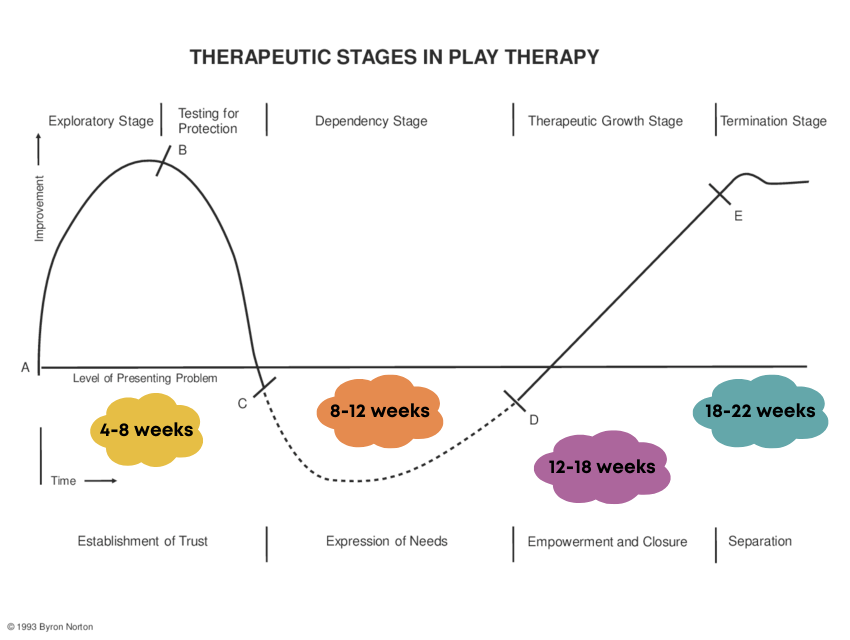
Stages of CCPT
1. Initiation / Exploratory Phase
In the first 4–8 sessions, the focus is on establishing trust and ensuring your child feels safe. They learn what to expect, become familiar with the therapist, and explore the playroom at their own pace. Some children dive straight in; others move more cautiously.
During this phase, the therapist responds with empathy and gentle guidance, helping your child feel empowered and comfortable taking the lead in play. Parents and carers can support this adjustment by being patient, validating feelings, and encouraging participation.
2. Resistance / Negative Reaction Phase
Once your child feels secure, deeper emotional work begins. This phase may involve challenging behaviours, emotional dysregulation or regression. Although the names sound concerning, this stage simply reflects the discomfort that naturally accompanies change. Children begin confronting old patterns and learning new, healthier ways of expressing themselves. Parents and carers play a vital role by validating their child’s feelings and reinforcing confidence in their ability to do difficult things.
3. Growing / Working Phase
This is typically the longest and most transformative stage. Your child actively engages in growth, showing improvements in:
Self-esteem
Emotional regulation
Communication
Flexibility and resilience
Although occasional regressions may occur, these are normal and form part of developing new neural pathways. Consistency, empathy, and gentle reminders of your child’s developing skills go a long way.
4. Termination Phase
When your child consistently uses their new skills across different settings, sessions gradually reduce in frequency.
Whilst adults may see this as a celebration, children can sometimes feel confused or sad about ending a secure therapeutic relationship. The therapist helps create a meaningful and positive ending, reflecting on progress and reinforcing your child’s confidence. Temporary regressions may occur but usually resolve as children adjust to greater independence.